 The Raffles English Studio
What if the endless pile of GCE O Level English assessment books on your desk is actually the barrier to your A1 in English?
A guide to choosing English tuition in Singapore.
Confident English. Powerful Results.
Download this guide as a PDFA guide to choosing English tuition in Singapore.
Most students believe that more practice automatically leads to better results, yet they find their grades plateauing at a stubborn B4. It's exhausting to navigate the seeming subjective marking of Paper 1 and 2 without a clear roadmap. You don't need more drills; you need a strategic partner who understands the nuances of the 1184 syllabus. Finding the right O Level English tuition in Singapore is about moving away from generic instruction and toward precision coaching that targets your specific weaknesses.
We understand the pressure of the O level L1R5 for your JC or Polytechnic admission. This guide will show you how to decode SEAB-specific exam techniques and secure a top-tier grade through a results-first approach — including the shifts in the 2026 English O level curriculum, the Paper 4 e-Oral video responses, and how 1:1 feedback can transform your performance from average to elite.
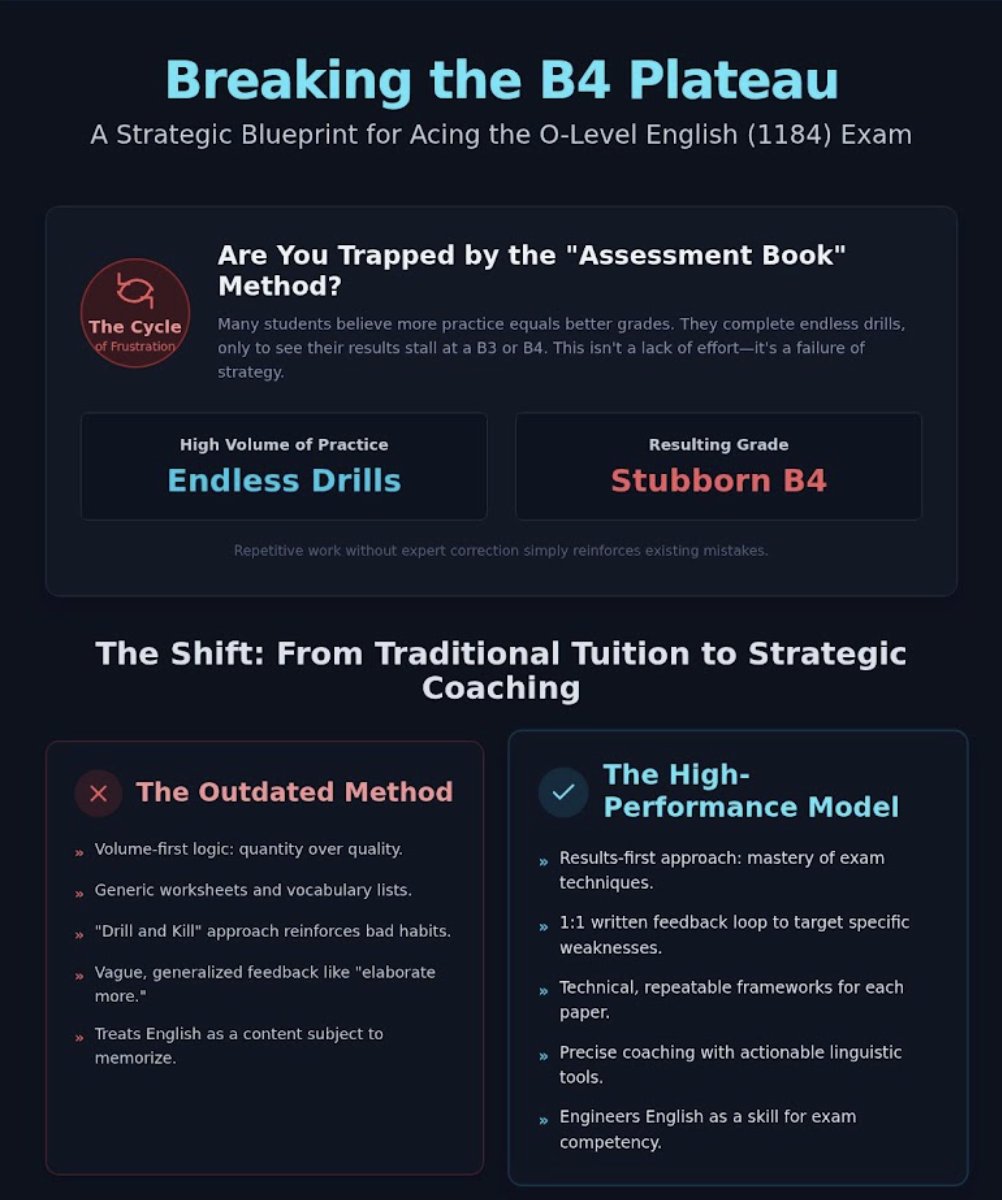
Many students in Singapore complete paper after paper, attend weekly classes, and yet their grades remain anchored at a B3 or B4. This plateau isn't a lack of effort — it's a failure of the traditional tuition model. Most providers operate on volume-first logic, prioritizing worksheets completed over the cognitive shift required to reach an A1. They treat English as content to memorize rather than a skill to be engineered.
For the 2026 examinations, the 1184 syllabus demands more than just knowing English — it requires mastery of functional communication and multimodal literacy. You don't need more practice; you need better strategy.
Repetitive essay writing without expert, forensic correction is counterproductive — it simply reinforces existing bad habits. If you write ten essays with the same structural flaws, you aren't practicing; you're perfecting your mistakes. Linguistic fluency is merely a baseline. Exam-specific competency is the true differentiator that separates the B3/B4 crowd from the A1 elite.
Unlike Mathematics, English students often don't know why they lost marks. Generalized feedback like "elaborate more" is too vague to act on. At The Raffles English Studio, our 1:1 essay feedback identifies recurring grammatical patterns and structural weaknesses unique to the individual — you stop guessing and start executing. It's a shift from correction to strategic mastery.
The SEAB 1184 syllabus rigorously assesses functional communication and critical reading skills. This isn't a general test of "being good at English" — it's a technical evaluation across four components: Writing, Comprehension, Listening, and Oral Communication. Understanding this framework is the first step toward mastery.
Many students are caught off-guard by the shifts in Paper 4: the traditional Reading Aloud section was replaced by a Planned Response involving a short video clip. This move toward multimodal literacy means you must analyze visual cues and spoken nuances in real-time. You can't rely on old strategies for a new system.
Success in Situational Writing depends on Tone, Audience, and Purpose. For Continuous Writing, "flowery" language often obscures the point and irritates markers. Instead of fluff or bare-bones bullet-copying, focus on a coherent story or strategic persuasion — moving beyond the basic PEEL method toward sophisticated storytelling or assertive argumentation.
Summary writing means identifying 8 points and paraphrasing them without losing the original meaning. Visual text analysis requires decoding irony and persuasive technique, not just describing a poster. When an examiner asks "how does the author show...", they want analysis of linguistic impact — not a summary.
Traditional tuition provides instruction — a broad delivery of content that assumes the issue is a lack of practice. Strategic coaching provides intervention, targeting the specific cognitive bottlenecks that prevent a B3/B4 student from reaching the distinction tier. It's the difference between being told what to do and being shown exactly how to improve.
For students headed to Junior College, a strategic mentor is even more essential — the O Level is a foundation for the A Level General Paper. A high-performance coaching model focuses exclusively on high-value skills like elegant paraphrasing, logical synthesis, and persuasive communication, mirroring the environments these students will soon enter.
By focusing solely on O Level English and A Level GP, we maintain an insider understanding of SEAB marking frameworks. We apply a "not this, but that" framework to every essay and comprehension response, using technical terminology and vocabulary precision that signal our students' competence — an advantage generalist centers simply cannot match.
Most "Top 10" lists prioritize location and marketing over pedagogical depth. Look beyond the storefront: does the center offer 1:1 written intervention, or just a letter grade and a generic comment? Alignment with the 2026 SEAB 1184 framework is non-negotiable — demand specialists, not generalists splitting time across subjects.
"How exactly will my child know why they lost marks in their last essay?" A marked paper with only a grade and "must improve grammar" is a red flag. Effective coaching requires forensic analysis that identifies recurring grammatical patterns — if a center can't answer this, they aren't coaching; they're just supervising.
The Raffles English Studio operates as a high-performance studio, not a generic tuition center, built on the technical reality of SEAB 1184 and SEAB 8881 marking standards. Your grade gap isn't usually a result of poor English — it's a weak feedback loop. We don't just correct; we engineer, transforming your writing into a strategic argument.
Success in the 2026 examinations isn't about the quantity of practice papers — it's the quality of your strategic feedback loop. As a SEAB-aligned curriculum specialist, our 1:1 written essay feedback on all drafts ensures every page is a step toward technical mastery.
At the beginning of Secondary 3, allowing gradual mastery before the high-stakes final year. Secondary 4 students often need intensive intervention six months before the exam.
Yes — by replacing generic practice with targeted coaching on high-ROI components: situational and continuous writing, comprehension, and the Oral exam (20% of the total weighting).
1184 is the framework for 2026 examinations; 1128 has been phased out. 1184 introduces e-Oral video stimuli and demands higher multimodal literacy.
Yes — specialized coaching for the Paper 4 "Planned Response" section, analyzing video clips and constructing assertive, logical responses.
School feedback is broad and class-oriented. Our 1:1 written feedback is forensic — isolating specific grammatical weaknesses and structural blind spots in every draft.
Yes — we function as a strategic partner for private candidates, providing SEAB 1184 alignment and personalized feedback to secure a distinction independently.
Your most recent school exam scripts and weighted assessment reports, so we can conduct a technical audit of your current performance.
We treat it as a technical extraction task: identify exactly 8 content points and apply precise paraphrasing techniques, rather than guesswork re-writing.
The ideal time to commence O Level English tuition is at the beginning of Secondary 3. This timeline allows for the gradual mastery of complex rhetoric and synthesis before the high-stakes final year. Secondary 4 students frequently require intensive strategic intervention six months before the exam to correct entrenched structural errors and plateauing grades.
Significant grade jumps are possible within six months if you replace generic practice with targeted coaching, focusing on high-ROI components like situational and continuous writing, comprehension, and the Oral exam.
Syllabus 1184 is the framework for the 2026 examinations while 1128 has been phased out. The 1184 syllabus introduces e-Oral video stimuli and demands higher multimodal literacy.
Yes — specialized coaching for the Paper 4 Oral Communication component, focused on the Planned Response section and constructing assertive, logical responses to video stimuli.
School feedback is broad and class-oriented; our 1:1 written feedback is forensic, isolating specific grammatical weaknesses and structural blind spots in every draft.
Yes — the studio functions as a strategic partner for private candidates, providing alignment with the 1184 syllabus and personalized feedback to secure a distinction independently.
Summary writing is treated as a technical extraction task: students learn a repeatable framework to identify exactly 8 content points and apply precise paraphrasing techniques.